How to tell if an education consultancy is truly student-centred
Most consultancies say they put students first. The real test is not what they say — it is what the student can see, understand and act on at every stage.
By Lana Shaugney

Many education consultancies describe themselves as student-centred. For students and families, however, it can be difficult to know what this really means. Most consultancies promise expert advice, personal support and help throughout the application process.
The real test is not what a consultancy says. It is how the student experiences its service.
Can the student see where they are in the process? Do they know what they need to do? Is it clear who is responsible for each step? Can they get an update without searching through old emails or repeating the same information? These questions show whether a service has truly been designed around the student.
A consultancy should reduce complexity. Applying to study abroad is extremely complicated. Anyone who went through it will attest to the complexity. Students may need to choose a country, university, course and entry route, all of this in a foreign language. They must also manage documents, deadlines, offers, visas, accommodation and travel.
For many younger students, this is their first major independent decision. It may also be their first time living away from home. A good education consultancy should make this journey easier and simple to understand.
However, some services create more confusion. Advice may be spread across emails, messaging apps, documents and calls with different advisers. The consultancy may understand how everything connects, but the student only receives separate instructions: send this document, complete this form, wait for a decision, prepare for the next deadline.
A student-centred consultancy does more than give correct advice at each stage. It helps the student understand how all the stages connect.
Universities show why continuity matters. They face the same problem, often on a much larger scale. Admissions, academic departments, finance, accommodation, student support and visa teams may all use different processes and systems. Each department may work well on its own, but the student still experiences one journey.
I have seen this from both sides. Having worked at the University of Warwick and Warwick Business School, I know that a large university can be difficult to navigate, even for an employee who speaks English fluently and understands how complex organisations work.
More recently, I needed to arrange a leave of absence from the University of Birmingham because of personal circumstances. I understood the UK education system and knew which questions to ask. Even so, I found the process stressful. Information was spread across webpages, emails, forms and documents. It was not always clear which guidance was current, who was responsible or what would happen next.
This made me consider how the same experience might feel to an 18-year-old international student using the system for the first time.
A consultancy cannot remove every complex university process. It can, however, help the student understand and manage them. It should provide continuity across universities, visa systems and other organisations. The consultancy should be a source of clarity, not another organisation the student must learn to navigate.
Five questions every student should be able to answer. At every stage, a student should be able to answer: Where am I in the process? What is happening now? What do I need to do? Who can help me? What happens next?
Answering these questions requires more than helpful advisers. Information must be current. Responsibilities must be clear. Deadlines and decisions must be recorded. Students should not need to search through months of messages or explain their history each time a new adviser becomes involved.
This is why a single source of truth matters. It means creating one reliable view of the student journey. The student, family and consultancy should share the same understanding of what has been completed, what is in progress and what must happen next.
What should students look for? Students and families should look beyond phrases such as “personal service” or “we put students first”. A genuinely student-centred consultancy should show the following qualities.
It explains the whole journey. The consultancy should explain what will happen from the first planning discussion through to enrolment and arrival. It should show how course selection, applications, documents, offers, visas and accommodation fit together.
It makes responsibilities clear. Students should know what they need to do, what the consultancy will do and what must be completed by a university or another organisation. Unclear responsibilities can cause delays and missed deadlines.
It records advice and decisions. Important advice should not exist only in calls or informal messages. Students should have a clear record of recommendations, decisions and outstanding actions. This is especially important when several advisers or family members are involved.
It communicates before problems arise. A good consultancy should provide reminders before deadlines and explain important changes. Students should not need to chase constantly for updates or discover too late that something has been missed.
Its recommendations are personal. A consultancy should be able to explain why a course, university or country is suitable for a particular student. Advice should consider academic ability, career plans, finances, location and personal readiness. It should not be based mainly on convenience or commercial relationships. Students and families should also feel comfortable asking whether the consultancy receives commission from recommended institutions.
It provides a clear view of progress. Students should be able to see what has been completed, what is waiting for a decision and what they need to prepare next. They should not need to ask repeatedly: has this been submitted? Is there an update? What happens next?
It provides consistent support. Different specialists may support the student at different stages. However, the student should not need to manage the handover between them. Each adviser should understand the student’s objectives, circumstances and previous decisions.
It uses technology to improve human support. Technology should make the service easier to understand. It should not replace personal advice. Students should still have access to an adviser who understands their situation and can use professional judgement when something does not follow the normal process.
Putting these principles into practice. These ideas shaped the development of Oxford Comma Compass, our centralised student relationship and service-delivery system. Compass connects the journey from the first discussion through to enrolment and preparation for arrival. It brings together the student’s strategy, applications, documents, decisions, deadlines and next steps.
Instead of reconstructing the process from old emails and messages, students and families can see what has been completed, what is currently happening and what they need to do next.
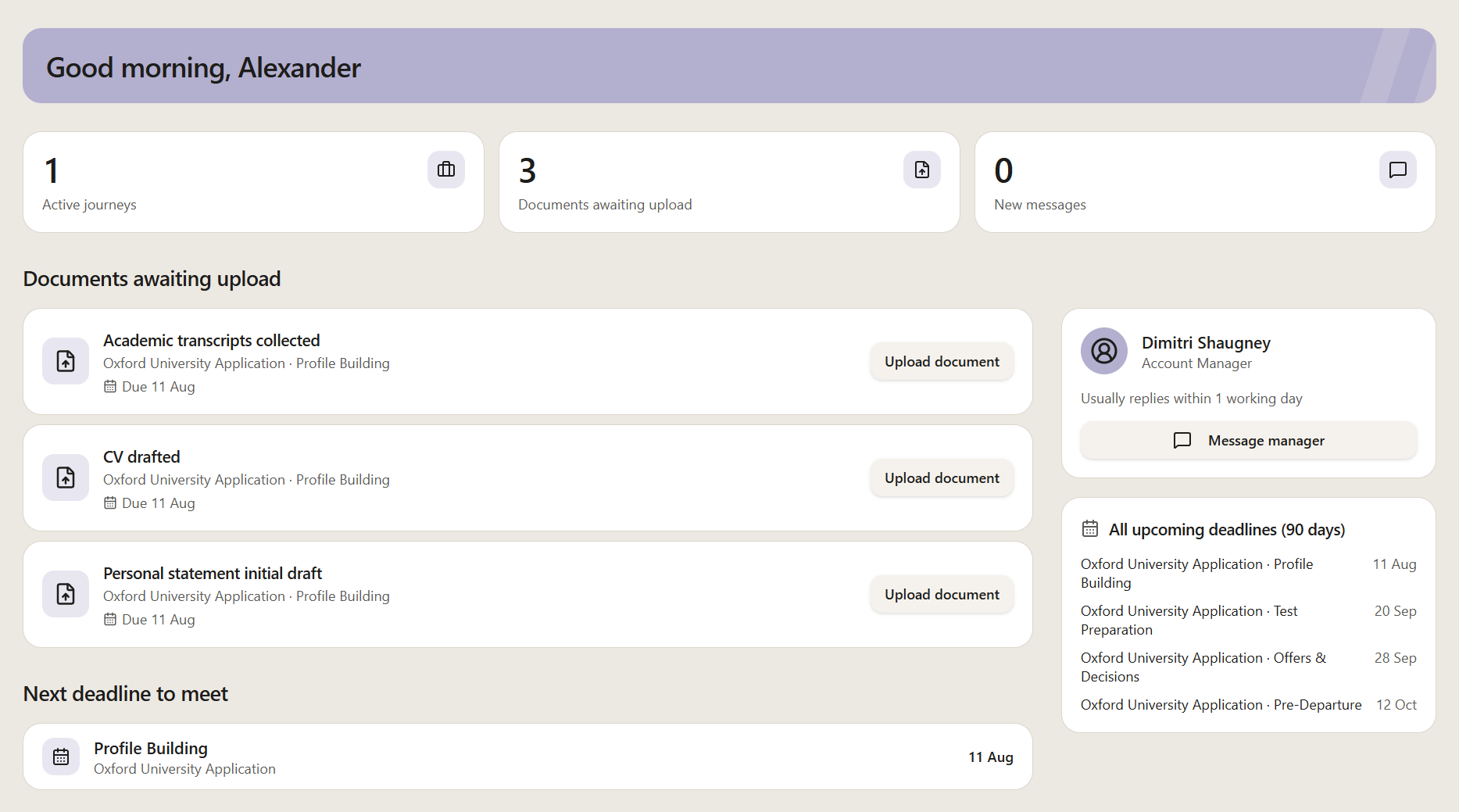
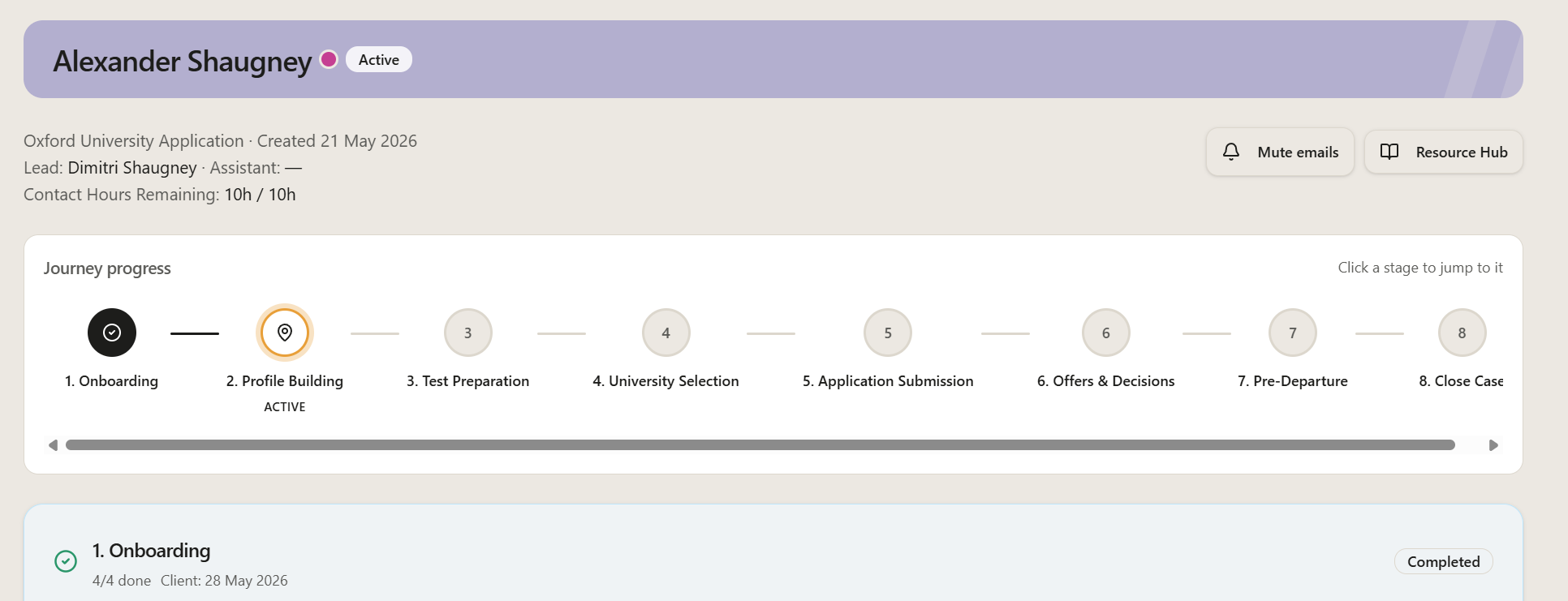
A rigorous process of development. Creating Compass was not simply a technology exercise. The work began with a detailed review of the student journey. We examined where students, families and advisers experienced delays, confusion or gaps in communication.
The system then developed through repeated cycles of design, testing and improvement. Early versions were tested against realistic student cases. Workflows were revised when they were unclear or did not reflect how decisions were made in practice.
We reviewed how applications, documents, communications, responsibilities and deadlines should connect. Each part had to be clear on its own while also supporting the full journey. The aim was not to copy an existing process into a digital system. It was to redesign the process from the student’s point of view. This matters because putting a confusing process online does not make it student-centred. It simply creates digital confusion.
Technology should create more time for students. The main value of Compass is not the technology itself. It is the clarity it creates. When students understand what is happening, they feel more in control. When deadlines and responsibilities are visible, there is less risk of important actions being missed. Families can also provide support without constantly asking for updates.
Clear systems also give advisers more time for meaningful work. Technology should handle routine organisation and make information easier to find. Advisers can then spend more time listening, explaining choices, providing reassurance and helping students make good decisions.
Student-centredness should be visible. Students should not have to rely only on promises that a consultancy puts them first. It should be visible in how the consultancy explains the journey, records advice, communicates progress and supports the student through uncertainty.
The most important question is not: does the consultancy’s process work internally? It is: can the student understand it, trust it and act with confidence?
International students often receive a large amount of information. What they need is clarity, continuity and a clear understanding of what comes next. That is what students and families should look for when choosing an education consultancy.